Pocoyo almost didn’t make it.

The little blue boy had won a BAFTA and a Cristal at Annecy. He had fans across 17 language markets. But in 2011, the Spanish studio that created him, Zinkia Entertainment, was drowning in debt. New episode production stopped. For the next decade, Pocoyo lived on YouTube specials — enough to stay alive, not enough to grow.
Then in 2023, a startup called Animaj bought the IP. Two years later, Pocoyo has 26 million unique viewers a month across 50 YouTube channels in 22 languages, a new season co-produced with Spanish public broadcaster RTVE, and a third feature film locked in for 2028.
What changed wasn’t the budget. Animaj isn’t a major studio. What changed was how long it takes to make an episode — down from five months to under five weeks, using AI tools trained on Pocoyo’s existing visual library to handle the frame-by-frame work between key poses.
The cost of doing it right
Solo Leveling offers a useful contrast.

Before A-1 Pictures aired a single frame in January 2024, the manhwa had already clocked 14.3 billion views worldwide. Demand was not the question. What it took to meet that demand was Sony, Aniplex, Crunchyroll, and Piccoma pooling resources into a production committee. According to A-1 producer Atsushi Kaneko, one episode took between 10 months and a full year to complete. Seasons 1 and 2 combined ran to 220,000 frames. The anime became the most-watched series in Crunchyroll history.
A-1 Pictures still posted a net loss of 178 million yen — about $1.2 million — for the fiscal year ending March 2025. Not because Solo Leveling failed. Because Japan’s production committee model routes profit to rights holders, not to the studio doing the frame work. Even at the top of the industry, the economics of animation don’t necessarily favor the people making it.
For a webtoon author without a Sony deal, or a regional character brand without an OTT relationship, that production structure simply isn’t on the table. That gap has always been there. Whether it’s still fixed is a newer question.
Where the money actually goes
It isn’t the creative decisions. A director deciding how a character moves during a fight scene, what the camera does, how the lighting shifts — that work is not what drives the cost up. What drives the cost up is executing those decisions across thousands of individual frames. Every movement that looks fluid on screen is built from drawings that fill the gaps between key poses. Those drawings have, until recently, required a human hand for each one.
When a webtoon gets adapted, the source panels already contain the key moments: the punch landing, the expression breaking, the scene opening on a wide shot. What the adaptation needs is everything in between. On Solo Leveling, where action sequences demand near-cinematic fluidity, the in-betweening work is where labor accumulates. That’s not a creative problem. It’s a production volume problem.
Animaj built tools specifically for this. On Pocoyo’s current season, animators draw the key poses from storyboard sketches. The AI fills the frames between them, trained on earlier seasons of the show so the output matches Pocoyo’s particular rhythm and style. In internal testing, that workflow produced a 67% reduction in time spent on in-betweening. Five months per episode became five weeks.
This doesn’t apply to every production. Studios whose hand-drawn style are a different case. Delegating that to automation isn’t an efficiency gain. It’s a category error. But for most webtoon and web novel adaptations, where the creative value is in the characters, the story, and the world rather than the animation technique itself, in-betweening is overhead. Expensive, time-consuming, and now partially addressable.
Keeping an IP alive has always been a race against being forgotten. New content had to come fast, and fast meant labor, more hands, more hours, more frames. That pressure didn’t disappear when a studio went bankrupt or a creator ran out of time. It just meant the IP went quiet instead.
What’s changed is who does which part. How a character moves in a scene that counts, what it needs to feel like. That still takes someone who knows the work. The frames in between, the ones that bridge those decisions rather than make them, are a different problem. AI doesn’t replace the judgment. It takes the volume.
Six people. Five months. 30 episodes.
CJ ENM ran a different experiment.

The studio behind Parasite and Queen of Tears didn’t acquire a dormant IP. It built one from scratch. Cat Biggie is a non-verbal short-form series about a cat who becomes an unlikely father to a baby chick. Six people made it in five months using CJ ENM’s in-house AI system, Cinematic AI. Thirty episodes, two minutes each.
To put that in context: conventional 3D animation typically runs three to four months of production for five minutes of finished output. Cat Biggie launched on YouTube globally in July 2025, crossed 10 million cumulative views, and was presented by CJ ENM at TIFF 2025 as a case study. The company’s chief strategy officer called it proof that AI could be applied “across the entire content value chain.”
Pocoyo and Cat Biggie aren’t the same story. One is a revival, the other is an original. But they point in the same direction: smaller teams, shorter timelines, and output that can reach global platforms without a studio infrastructure built for a different era.
What Solo Leveling changed for everyone else
Solo Leveling had a secondary effect.
After the anime launched, the manhwa’s readership in Japan climbed into the top 10 on Line Manga, despite the series having only entered the platform in May 2024. The CEO of LINE Digital Frontier announced a target of 20 new webtoon anime adaptations. Warner Bros. Animation entered a partnership with WEBTOON to develop its own slate. A Korean webtoon becoming the most-watched anime on Crunchyroll didn’t just validate one IP. It changed how the industry thinks about the format.
But Solo Leveling had Sony. Most webtoon IP doesn’t.
The readership is there. According to industry reporting based on KOCCA survey data, a majority of Korean webtoon readers already think about a title’s video adaptation potential while reading it. The expectation for animation is baked in before any adaptation exists. What most independent IP is still missing is a way to actually meet it.
What this means for webtoon and web novel IP
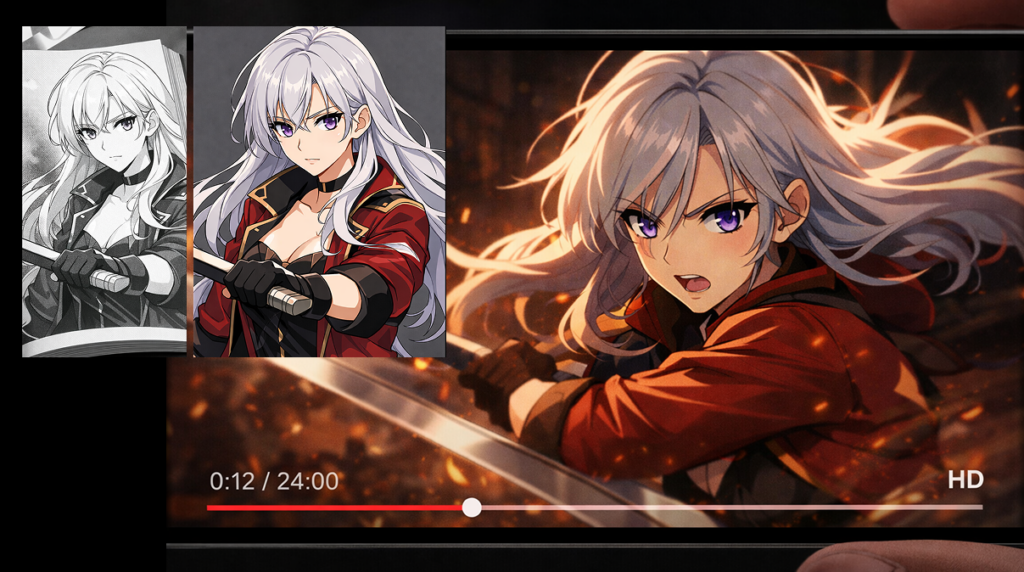
CineV is built for this specific format: anime-style animation adapted from webtoon and web novel IP.

The technical requirement that distinguishes this format from general AI video generation is character consistency. A reader who has followed a character for 200 chapters has a specific idea of how that character looks, moves, and reacts. A tool that generates plausible anime footage isn’t the same as a tool that keeps that specific character coherent across scenes and episodes. General-purpose video generation solves the first problem. The second is what CineV is designed around.
The production cost barrier that has historically separated IP holders with studio relationships from those without is narrowing. That’s what Pocoyo shows, and what Cat Biggie confirms from a different angle. For webtoon authors and story IP holders with audiences but without pipelines, the question has shifted. It used to be whether animation was financially possible. Now it’s whether the character you’ve built can survive the translation.
If you’re thinking about what that process looks like in practice, this guide walks through how IP holders are using CineV to build an anime series from existing characters:
Try It With Your Own Character for free
Free credits are included when you sign up. No payment required to get your first scene running.
Frequently Asked Questions
Sources
- Animation Magazine · June 2025 · Animaj $85M funding · View Original →
- C21Media · March 2026 · Animaj defends AI use · View Original →
- Variety · June 2025 · CJ ENM Cat Biggie · View Original →
- CJ ENM Newsroom · September 2025 · TIFF case study · View Original →
- CBR · September 2025 · Solo Leveling production structure · View Original →
- Screen Rant · June 2025 · A-1 Pictures financial loss · View Original →
- Kakao Entertainment · January 2024 · Solo Leveling anime launch · View Original →
- Screen Rant · March 2025 · Webtoon anime expansion · View Original →
- Animaj · Motion-In-Betweening technical breakdown · View Original →
- Bandinews · December 2025 · Korean webtoon IP trends · View Original →